M‑01‑26

The
Systems

People are nervous. Nobody says it out loud, but it’s in everything you hear: the news clip, the video someone sends around, the story about this job or that one. This business has been taken apart and put back together more times than I can count, and now someone can type a sentence and get back something that calls itself a film. I don’t know what that turns into yet. Neither does anyone else, whatever they tell you.

What I do know is the part that never moved. I’ve watched formats, cameras, markets and distribution get torn out and rebuilt, several times each, over thirty-five years. Through all of it the money has moved the way it moved in 1995. That is the thing worth fixing, and it can be fixed.

Introduction

Thirty-five years in production, in all three of the businesses that live on it. Music videos first: Jay-Z’s first video, early Bad Boy, Mary J. Blige. Then film. Pi went to Sundance, and Requiem for a Dream came after it. Then two decades of advertising and editorial, Victoria’s Secret, Nike, YSL, W. Three production companies with my name on the lease.

I’ve been the owner and I’ve been the freelancer. I’ve hired hundreds of people and I’ve waited to get hired. Both sides of the desk, long enough to know the view from each.

What Changed

There was always a side door. I came in through it. Getting in was the whole game then and it still is, but in those days there was a second wall right behind the first, because whatever you made had to stand next to a studio picture and nobody graded on a curve. So you chased production value and you pulled it out of wherever you could find it. A location somebody’s family owned. A rental house doing you a favor. A crew working on a promise. We were after a 70mm look on 16mm, and when we didn’t get there we got away with it, because it looked like exactly what it was.

The bar sat that high because of the film itself. Stock was finite, and you were blind until tomorrow. Exposing thousands of feet properly meant the lighting was right, which meant the gaffer was right, which meant the prep was right and the schedule was honest. Every part leaned on every other part. The care this took was extraordinary and completely routine at the same time, and a do-over meant something had actually gone wrong.

Now a phone shoots 4K, and shoots it in slow motion while it’s at it. If that had existed in 1996 we would have used every frame. And it didn’t stop at the camera. You can finish at home, put the work out yourself, and find an audience without anyone’s permission. Production opened up and distribution opened up right behind it. This business has never been more open, and that is the best thing that has happened to it in my working life.

The math that follows is simple. A field that was already full of talent is flooded with it now. Doing the work properly still means the best person in every department, and that still costs what it costs. But the number of people willing to work for any number, or for nothing, or to fund the job themselves for the reel, has never been higher. That was always true at the start of a career. It is now true across whole categories of work, and it sets the price for everyone in them.

If you want one number for how completely the ground turned over: Kodak runs three motion picture labs on the planet. New York, London, Atlanta. Los Angeles alone had more than that in the nineties. Deluxe closed its Hollywood lab in 2014. Technicolor closed its own after a hundred years. Hardly anyone stopped to mark it, because the work kept coming.

What Didn’t Change

Money moves in seconds now. You can settle a mortgage, buy a car, or send payroll to another continent before lunch. Ours moves the way it moved when I started, and not because it has to. Everyone up and down the chain has worked out that holding money a little longer is the cheapest financing there is. Accounts used to be net thirty and everyone ran on the same clock. That clock has only ever broken in one direction.

Everyone wants the best people. It makes the work better and it makes the buyer look good. When the budget doesn’t reach, the job goes to second best, priced as if it were one for the reel. That used to describe a favor between friends. Somewhere along the way it became a pricing strategy.

So the producer becomes the bank, without any of the things that make banking survivable. No interest. No late fee. No consequence for paying months late, and it is always months. You sign the agreements. You carry the insurance. You guarantee a package worth more than your house. And when the money isn’t there on Friday, you cover payroll yourself, because forty people have rent due and not one of them should ever have to know.

And it isn’t only payroll. The whole job is a carry. A job gets awarded, shot, delivered and forgotten inside a month, two at the outside. Every expense on it came due long before the money for it arrived. You close out a job that ended in the spring with money that lands in the fall, and everything in between is yours.

Editorial has the same problem in a different currency. It never paid much and never had to, because the tearsheet was the payment. A strong editorial is still how a brand decides what a photographer, a model or a stylist is worth. That bargain held when a handful of titles could confer a level. Now it runs at platform speed, against everyone on earth, and the credit falls off the file the moment the work leaves the page. Paid in credit, and the credit doesn’t even stay.

Nothing has been built to fix any of this. Nothing that pays a crew quickly. Nothing that closes a job cleanly. Nothing that keeps a credit attached to the work it belongs to. We rebuilt the camera, the cut, the color, the delivery, the distribution and the screen. Every advance of the last forty years went into the picture. Almost none of it went into the money.
The Fix

There is nothing wrong with the people in this business. They are the toughest, fastest, most resourceful group I have ever worked with, and they solve harder problems before lunch than most industries see in a quarter. What they've never had is anything underneath them.

Think about what a production company actually is. It exists for the length of a job. It signs the agreements, carries the insurance, makes the payroll, holds the credits, and then it's gone, and the next job starts from nothing. Your record of the work lives in a folder on someone else's server until the server goes away. Who you were on that job, what you were paid, who booked you, what the job cost, who said yes to what and when: none of it is kept anywhere that outlives the job.

The way this business actually runs has never been written down anywhere but in people's heads. Considerations. First and second holds. The challenge. The offer. A credit that only becomes real when it's given. Everyone knows the rules, and nothing enforces them, which is why the money is the part that always slips.

A production company that didn't dissolve at wrap would hold all of that. One record of you that belongs to you. One record of the job. The etiquette written in, so it stops depending on who's in the room. Productions would pay for it, because productions already pay for every piece of it separately. The people doing the work would never be the customer, because they never were.

That's a wrap

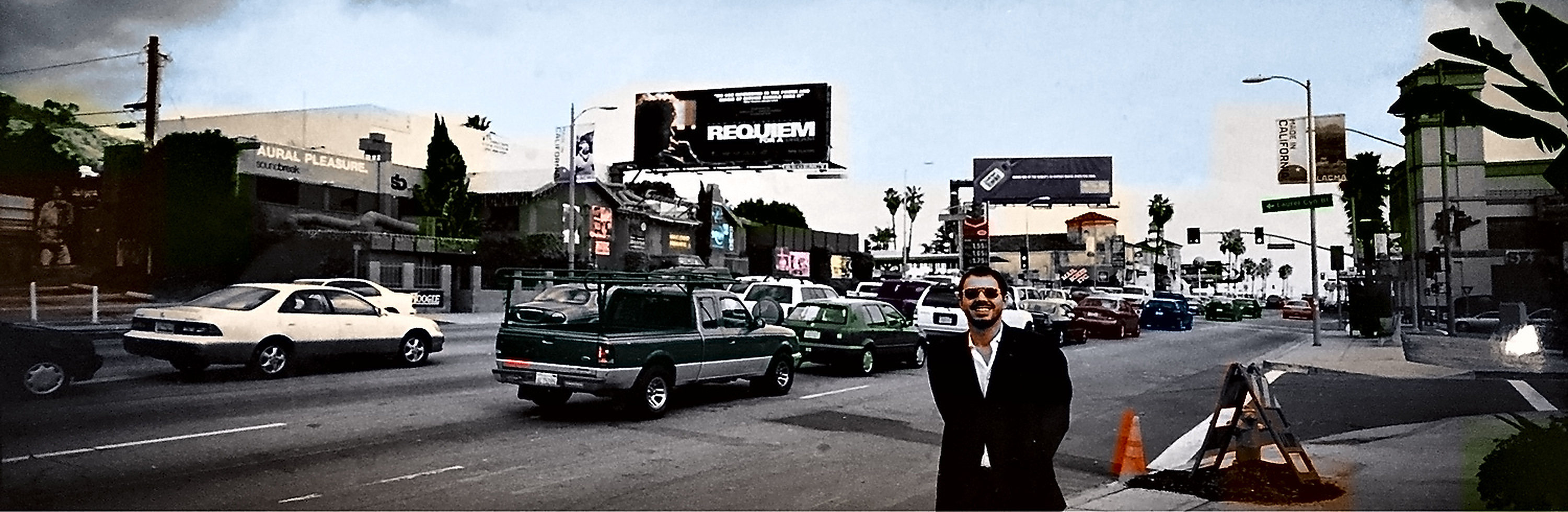
Sunset Boulevard at Argyle, traffic in the foreground and a Requiem for a Dream billboard above the street. M. Scott Vogel stands at the kerb.
Fig. 1 — Argyle and Sunset Blvd, 2000. Producer M. Scott Vogel. Photograph by Nitin Vadukul.

Every era of this business was built by people who picked up whatever was new and ran, while everyone else was still deciding whether to be afraid of it. That is who this industry is. It has never once failed to find its way through a change, and I don't expect it to start now.

The List